
Library Record
Images

Metadata
Title |
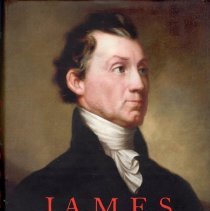
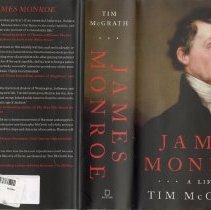
James Monroe - A Life |
Object Name |
Book |
Summary |
James Monroe - A Life James Monroe was born April 28, 1758 into a prosperous Virginia family. Following nominal home schooling, he was enrolled in a small private boarding school. Then followed admission to William and Mary College in Williamsburg, Virginia. There he met an older student, Thomas Jefferson, who was to become his dearest friend and mentor. With the advent of the American Revolutionary War, James aspired a military career. He soon became a lieutenant in the Virginia Militia and by December 1776 he was attached to the Continental Army. James was with George Washington when he crossed the Delaware River and attacked the Hessian mercenaries at Trenton, New Jersey on December 26, 1776. Lieutenant Monroe was badly wounded during the battle and was carried back across the river to begin a lengthy convalescent. After his recovery, he was not engaged in significant battles. However, he continued to take an active role in the army and ultimately became a Lieutenant Colonel by the end of the war. James desired a military career. However, he returned to William and Mary where he studied law and pursued a political career. His friendship with Jefferson motivated his career in Virginia state government followed by service in the federal government. When Jefferson became president in the election of 1800, Monroe was sent to Paris where he was one of the principal negotiators to purchase New Orleans and the immediate surrounding area. Napoleon had acquired most of the area west of the Mississippi by conquest from Spain. However, he needed money to sustain his military aspirations. Therefore, he offered to sell what was to become the Louisiana Purchase for approximately $13,000,000. Monroe hastily arranged bank loans in England and Amsterdam and sealed the deal. Monroe had become a friend of Madison and became Secretary of State during Madison's first administration. During the War of 1812, it became evident that the United States was ill prepared to defend itself on land and sea. Therefore, following the British burning of Washington, he accepted the additional duty of Secretary of War. In subsequent years, he would consistently seek to improve our military strength. He took specific interest in the construction of military forts at the entrances to America's harbors. The War of 1812 was "officially" concluded with the Treaty of Ghent in December 1814. However, the British had already initiated a huge military commitment to capture New Orleans and control of the Mississippi River. They were already landing thousands of British soldiers a few miles south of New Orleans by mid-December 1814. Fortunately, General Andrew Jackson was aware of the pending battle for New Orleans. He arrived in New Orleans and established martial law while gathering an army of veterans and thousands of volunteers from Tennessee and Kentucky. He also sought the support of freed slaves and Indian tribes. And, he was persuaded to gain the large colony of pirates that lived along the Mississippi Delta. The first combat began December 23, 1814 when Jackson learned of the British landing on the peninsula about 15 miles south of New Orleans. The defense of the city was finalized January 8, 1815 with a huge victory for Jackson. It proved to be one of the most strategic battles in American history. James Monroe won the election of 1816 and became the last president that had been a military officer during the Revolutionary War. His tenure in office was generally peaceful but faced many economic challenges. It also included western expansion and continued the political issue of slavery. Henry Clay, from Kentucky, became Speaker of the House, and helped negotiate the Missouri Compromise that deferred the slavery issue until the election of Lincoln in 1860. Monroe's greatest legacy was the Monroe Doctrine. Following his presidential years, he returned to his home in Virginia. He had always experienced financial problems and had to sell most of his inheritance to liquidate his debts. |
Object ID |
2023.117.001 |
Call# |
HIS MCG |
Author |
Tim McGrath |
Published Date |
2020 |
Subjects |
History |
Search Terms |
Monroe Monroe Doctrine |
People |
Monroe, James |
Collection |
AIMH |